Episode 148 Utilizing Assessment to Bond with Kids…Starring Layne Neuhart

This seems like a totally incongruent title. How in the world can you use assessment to forge strong relationships with students? And yet in this episode. My guest and I will attempt to answer this question. The key is student revision based on teacher feedback. Two tech tools that are instrumental in this process are the Google extension Mote and an app called Voxer. Both will be featured in this episode.

Educators need to stop conducting assessment as an event and transform it into more of a process. Students learn so much when they go back and fix and improve. Successful revisions typically take a healthy collaboration between students and teachers. That, dear friends, is fertile ground for relationships to evolve. 

To help in this interesting exploration, I conscripted one of my students. Layne Neuhart is a wonderful person. She has a bottomless intellectual curiosity and is a blast to interact with. She’s going to be a champion at forging positive relationships with the lucky students that will one day be in her language art class. 

 Layne Neuhart [email protected]

Before we get to the episode, I want to give a shout out to the text we utilize in my assessment class. Classroom Assessment for Student Learning by numerous authors is a wonderful resource. It’s in this text that I found a template that I apply to all of my lessons. This template is called The Seven Strategies of Assessment for Learning. Below are the seven. I would strongly urge listeners to start applying this template to all of their lesson creations:

  1. Make certain that students understand the learning target.
  2. Provide examples of strong and weak work.
  3. Provide regular descriptive feedback.
  4. Teach and then encourage self-assessment.
  5. Focus on just 1 learning target per prompt.
  6. Teach and encourage students to revise their work.
  7. Encourage students to collaborate.

Episode Template

The Problem:

Teachers need to form stronger bonds with students. 

The Solution:

Teachers need to leverage assessment to bond with kids.

What you can do Tomorrow: 

  • Apply the The Seven Strategies of Assessment for Learning to tomorrow’s lesson plan.
  • Explore possibilities with Voxer. 
  • Explore possibilities with Mote.
  • Insert revision and collaboration opportunities into your next assessment. 

Stop thinking about assessment as an event and think of it as more a process. The resulting collaborations you have with students could be magical. 


Episode 147 Do your Kids Know CRAP about Evaluating Online Resources…Starring Kaylie Callihan and Josh Hilgenberg

Daniel Patrick Moynihan was an iconic Democratic senator from New York. One of his most famous quotes was, “You are entitled to your opinion. But you are not entitled to your own facts.”

Decades ago, Americans embraced this stance. 

On January 6, 2021, a mob attacked the U.S. Capitol. These insurrectionists were inspired by their own set of facts. Their claims of election fraud have been roundly rejected by Republican appointed judge after Republican appointed judge. The Supreme Court, which includes 6 conservatives, declined to even hear the case. These are inconvenient facts for those who laid waste to the capitol that day. Why would normal members of far flung communities be willing to risk their reputations, their jobs, their family relationships, and their freedom for an idea that has not stood the test of objective judgement? The answer is that they have undermined Senator Moynihan’s directive and now live in a world created by their own set of facts. Most came to this paradigm through a wholesale diet of unreliable online sources. 

The attack on the capitol should be a wakeup call for educators. We have a moral obligation to help students evaluate online sources. Perhaps through our efforts, kids will develop a healthy skepticism about all sources. Unfortunately, many contemporary adults have trained their young to reserve their skepticism only for those sources that emanate from the other side of the political divide. Contemporary media literacy should encourage a healthy skepticism toward all sources. 

Before I describe my guests, I’d like to first promote the text that we use in my Education Technology class. Educational Technology for Teachers by Dr. Gregory Francom is user-friendly, interactive, and engaging. Dr. Francom dedicates an entire chapter to information literacy. This chapter was our focus this past week. 

To help tell this story, I deputized two outstanding aspiring teachers. Kaylie Callihan and Josh Hilgenberg are both students in my technology class. They consistently produce stellar creations. 

[email protected]                                    [email protected] 

Last week, our focus was information literacy. My students were challenged to create a prompt for their future classrooms. This prompt would encourage students to evaluate online sources. A key aspect of their creations was a short informational flipped presentation. This would provide the class with basic information about information literacy. I challenged Kaylie and Josh to use PowerPoint and YouTube to create this flipped presentation. They put together marvelous videos. Here’s a link to Kaylie’s and here’s a link to Josh’s. But the bulk of our conversation is dedicated to the dissemination of the acronym CRAP. Intrigued? I thought so. 

Episode Template

The Problem: Students lack an evaluative template for online sources.

The Solution: CRAP

What you can do Tomorrow: 

  • Utilize Kaylie or Josh’s flipped presentations.
  • Gather some reliable and problematic online sources in your subject area.
  • Challenge students to evaluate these sources utilizing CRAP.

Encourage your students to think objectively, to think critically, and to question the legitimacy of all sources. 

146 Moving Past COVID…Starring Ryan Mocarski

I’ve always been fascinated as to how calamities, such as war, lead to innovations that benefit humankind long after the conflict abates. WWII, for example, sponsored all of the following:

  • Antibiotics
  • Radar
  • Jet Aircraft
  • Computers
  • Satellites

The old adage Necessity is the mother of invention could be applied to each of these quantum technological leaps. In each case, one side in the conflict was attempting to develop advantages that would lay waste to their enemy. The unintended consequence, however, was that these inventions vastly improved civilian existence after the conflict. I could not fathom my life without any of these WWII byproducts. This realization got me thinking. I wonder if the catastrophe of COVID will spawn better ways to educate kids. 

To help explore this rhetorical question, I tapped a former guest, Ryan Mocarski. 5 years ago, on Episode 31, Ryan promoted the idea of self-directed learning. In this episode, we’ll speculate about transitioning out of COVID.

[email protected]

Episode Template

The Problem:

Teachers struggled when they were forced to become virtual educators during COVID–and now that it’s winding down, they’re struggling making the transition back to more traditional teaching. 

The Solution:

COVID has changed education. Embrace this and be willing to change as well. 

What you can do Tomorrow:

  • Take an inventory of how you’ve taught differently over the last 12 months.
  • What strategies have worked and what have not?
  • What have you liked about teaching this way?
  • What strategies or tactics that you utilized during COVID could you perhaps utilize in more traditional leaning settings? 
  • Collaborate with colleagues about these questions.
  • Be open to new ideas that your administrators propose. 

My old high school Biology teacher had a saying, Species can either migrate, mutate, or lay down and die. In order to thrive you must be willing to mutate. 


145 The Legacy of a Lesson…Starring Ty DeLong

The best thing about social media is that it keeps you connected with significant people. It’s kept me connected to many former students. I’m going to talk to one today. Ty DeLong was a student in my Economics class almost 2 decades ago. Ty lives in Nashville. He’s a software engineer. He’s a devoted husband and father. I’m really proud of him.

Blaise, Ty, and Dolly DeLong
[email protected]

A few years back, I ran into Ty’s parents at a local store. My wife and I caught up on the doings of Ty and his siblings, but at one point in the convo, his parents mentioned the positive impact of a lesson from my class on Ty’s life. WOW–that thrilled me.

Today’s episode is going to be on that lesson, why and how it impacted Ty, and the incredible responsibility and potential for every educator whenever the bell rings each period and each day.

Episode Template:

The Problem: Teachers sometimes forget the potential for each lesson.

The Solution: Each period, before you utter your first word, keep in mind the potential legacy of the lesson.

What you can do Tomorrow:

1. Make a list of intense learning experiences that impacted you. Evaluate what it was about these experiences that caused great impact.

2. Make a list of lessons that former students have complimented you upon. Evaluate that lesson. Why do you think it made an impact?

3. And finally, evaluate tomorrow’s lesson. Are there any adjustment’s that you could make which could improve its legacy

Teaching is a powerful job. You may be totally unaware of the impact you’re having. Just make certain, that when someone walks up to you decades later and reminisces about your class, that it’s a positive memory.

144 Middle School Science Teacher Shane Neiffer Explains HOW to Make Your Class Enthralling

Last week was exhilarating. My wife and I had become determined to install a subway tile backsplash in our kitchen. I thought to myself, There’s no way I’m going to pay someone to do that. I’ll learn how and do it. Of course, I went to the greatest educator in the world–YouTube. I watched a number of how-to videos, gathered my courage, and then installed that backsplash. It was a profitable and empowering exercise. I love my new backsplash and the experience gives me confidence to take on more such challenges.

Are you willing to gather your courage and try something new in your classroom? Covid has forced us to adapt and take risks and wouldn’t you agree that there have been experiences over the past few months that have evolved you as a teacher? I’ll wager that when this crisis abates that you’ll find yourself teaching differently than before Covid. Times such as these afford you the opportunity to try new things and take risks. 

And this, dear listener, is where Shane Neiffer makes a glorious appearance. Shane is a middle school science teacher in Eastern Pennsylvania. She’s developing a sparkling reputation as an innovator. She takes a subject that many students dread–Science and makes her class the one her students are gabbing about around the dinner table that evening. 

Shane Neiffer  [email protected]

In this episode, we’ll talk about exactly HOW she does it. It’s one thing to hear about someone doing something, but it rises to a whole new meaningful level when they demonstrate. Think back to my subway tile backsplash example. Without YouTube, I’d have been lost. That is the magical thing about what Shane has done for you in this episode. You simply must navigate to my show notes and then access the link to Shane’s Resources. This doc is a student engagement roadmap. She indicates the objective and then provides the tool to fix it. She’s compiled 30 different tools that can be utilized to achieve the various objectives she has listed. This is a powerful resource that I’m going to apply in my classes next semester. I challenge you to take a look and NOT find something that you’re going to use tomorrow. That is why in the title of this episode the word HOW is in all caps. Shane, like YouTube, gives you the how. This is a magnificent resource for Covid and beyond. 

If you’re an administrator and you’re looking for PD for your teachers, Shane would be an excellent choice. I definitely see instructional coaching in her future. But after having said all those wonderful things about her, I would be remiss if I left out the most important part–she’s a really neat person. I’ve known her for a grand total of two weeks and I feel like I’ve known her most of my life. This woman is a technocrat and a highly engaging person. That dear friends, is a wonderful combo. I love this interview!

Episode Template

The Problem:

Teachers are adverse to taking risks which would make their classes more engaging. 

The Solution:

Utilize Shane’s Resources and follow her pioneering example of being willing to try new things. 

What you can do Tomorrow:

Focus on a way that you’d like to improve your instruction.

Search Shane’s Resources for a solution,

TRY IT TOMORROW.

Tomorrow, you’re going to utilize a new approach to teaching an old lesson. Your world will never be the same. 

Episode 143 Helping the Technologically Disadvantaged Student…Starring Jalen Wells

Covid has forced educators to take portions of their instruction, or all of their instruction, online. It’s quite an adjustment for all concerned. But imagine, and perhaps you’ve faced this, that a significant portion of your student’s home technology setup is inadequate, or non-existent. What do you?

In this episode, we’ll ask Jalen Wells this question. Jalen teaches history at Great Mills High School in Great Mills, Maryland. Many of his students have such technological obstacles. Covid has multiplied exponentially this digital divide. Jalen will talk about what his school has done and what he has done to help these students. 

[email protected]

And, I must exercise full disclosure. Jalen will become my son-in-law next summer. I’m so excited about the prospect of having another teacher in the family. And, a high school Social Studies teacher like I was to boot. I’m fascinated by his teaching journey and we talk about it a lot. As Jalen describes his struggles teaching students virtually in this interview, consider your students. What obstacles do they face? What adjustments can you make? Who can you look to for help? The past six months have presented unbelievable challenges to learning. Perhaps, this episode will inspire a solution that you can implement to help your students tomorrow. 

Episode Template:

The Problem:

Many students have significant obstacles to virtual learning. 

The Solution:

Identify who needs help and utilize resources to find solutions.

What you can do Tomorrow:

  • Make a list of your students who face virtual learning obstacles.
  • Create a roster of communication options.
  • Form a problem-solving group of like-minded colleagues. Together, you can brainstorm solutions. 
  • Investigate ways to leverage tools housed in your learning management system. 

Virtual learning has created challenges. Your solutions to these challenges has the potential to make you a better educator.

142 Four Ways to Dramatically Improve your Next Zoom Call…Starring Bernard Johnson, Christian Manna and Emily Montgomery

Clockwise from upper left…Emily Montgomery, Christian Manna, Bernard Johnson, and your humble narrator James Sturtevant

The first time I was a participant in a Zoom call, I was so impressed. It felt so futuristic. I thought highly of it and was excited to do another.

Covid however, like with many things we treasure, wiped out this euphoria. Zoom calls sprouted up everywhere. I grew to dread the dreaded Zoom call invitation. Here are some reasons why:

  • They’re too many participants.
  • They’re not engaging.
  • They’re too long.
  • Most are time and place bound.

In this episode, I’ll offer a remedy to each of these problems. Here are four objectives that I follow in my engaging Zoom call quest:

  1. small intimate experiences
  2. highly engaging preparation and discussion prompts
  3. 30 minute call limit
  4. recorded and made available to non-participants

I’d like to take each of these objectives and go into a bit more depth.

Small Intimate Experience

I’ve been on calls that had over 50 participants. In these experiences, only the organizers were talking. Granted, questions were raised in the chat feed, but there were few of those and they did not command much attention. I, like many of the participants, muted my video feed and worked on other things while the call droned on in the background. The participants in this scenario are more an audience. That’s not what you want. I say limit the number of participants to 4 or 5. 

Highly Engaging Preparation and Discussion Prompts

Engaging topics is an obvious key to a successful Zoom call. I accomplish topic engagement in 2 ways: 

  1. I make certain that participants consume outstanding preparation material prior to the conversation. 
  2. I inspire call participants with great prompts during the call. 

30 Minute Call Limit

This is just common sense. Keep the call short. I was recently on a 90 minute call. After 30 minutes, I couldn’t wait to get away from my computer.

Recorded and Made Available to Non-Participants

I have 20 students in my class. My Zoom calls generally consist of 4 participants. Zoom gives you the option to record the call, which is awesome! One major drawback to Zoom calls that consist of the entire class is trying to get everyone in front of their computers at a certain time which is outside the class meeting time. A smaller participant Zoom call can be recorded and then be delivered as an on-demand resource to the remainder of the students. They can then watch in their own time and at their own pace. I then prompt the non-participating students to submit a written reflection inspired by the prompts in the Zoom call. 

In this episode, 3 students Bernard Johnson, Christian Manna, and Emily Montgomery will describe their experiences with my Zoom call template, both as a discussion participant and watching the recorded convo and writing a reflection. 

This interview also mirrors one of our Zoom call discussions, because it’s a Skype Team Chat and all of us are in different locations. 

Episode Template

The Problem:

Zoom calls need to be more engaging.

The Solution:

Apply the 4 objectives described in this episode

Your Next Steps:

  • Find 4 student volunteers willing to engage in a Zoom call
  • Find an engaging topic, assign the students a resource to consume prior to the chat, and then create some provocative prompts based on the resource.
  • Record the chat and then make it available to the other students in your class.
  • Challenge the non-participating students to write a reflection based on the recorded call.

Conducting engaging virtual class discussions is an essential skill in modern education. You may as well get great at it! 

141 Veteran Music Educator Robert Trocchia Takes us to the Mountaintop

In the fall of 1979, I was a freshman in a college dorm trying to adjust to my new surroundings. One thing that I’ve always done to ground myself has been to play the music that I love. I grew up in a small town in Southeastern Ohio that was not diverse. And yet, my musical taste was totally urban. I loved the Isley Brothers and the Brothers Johnson and Earth Wind and Fire. 

One transformational afternoon, I put on some of my jams, which inspired a guy a couple of doors down to walk to my room, pop his head in, and then joyously proclaim, “I can’t believe you’re listening to these jams. I didn’t think anyone on this floor loved the Isley Brothers.” That guy was Vince Trocchia and a lifelong friendship evolved from this initial interaction. 

In October of that magical year, Vince invited me to his house for dinner. I eagerly accepted. I was treated to a magnificent Italian meal and met Vince’s wonderful family. I was so intrigued by his dad Robert.

Robert Trocchia [email protected]

Robert was the iconic local music teacher at Fairfield Union High School in Breman, Ohio. 

His choir from a small Ohio town:

  • Performed in many of the great cathedrals in the western world
  • Appeared on nearly fifty TV shows
  • And was named one of the top high school choirs in the United States.

It was evident from the moment that I met him how much Robert loved his life. I had no idea what I wanted to do with my future at this point, but his example impacted me. I viewed him as immensely rich. This evaluation had nothing to do with his stock portfolio.

Robert is now 86-years-old. You would never guess that when you listen to his powerful voice. He seems exactly the same to me as he did forty years ago. 

When I learned that Robert authored a book about teaching, I knew that I had to get it and that I had to have him as a guest on this podcast. Mountaintop Moments is a wonderful book for any teacher, at any grade level, teaching any subject. Embrace the message of this wise sage! 

What you can do Tomorrow:

  • Select a book to help in your quest to become a better educator.
  • Ask for a piece of advice from a veteran educator.
  • Inject a fun activity into tomorrow’s lesson.
  • Set a wonderful example for your students

Veteran educators like Robert are national treasures. Follow Robert’s directives and thrive in this noble calling.


140 Formative Assessment that’s Engaging and Relevant…Starring Aurora Dollins, Brianna Pasco, and Alex Staton

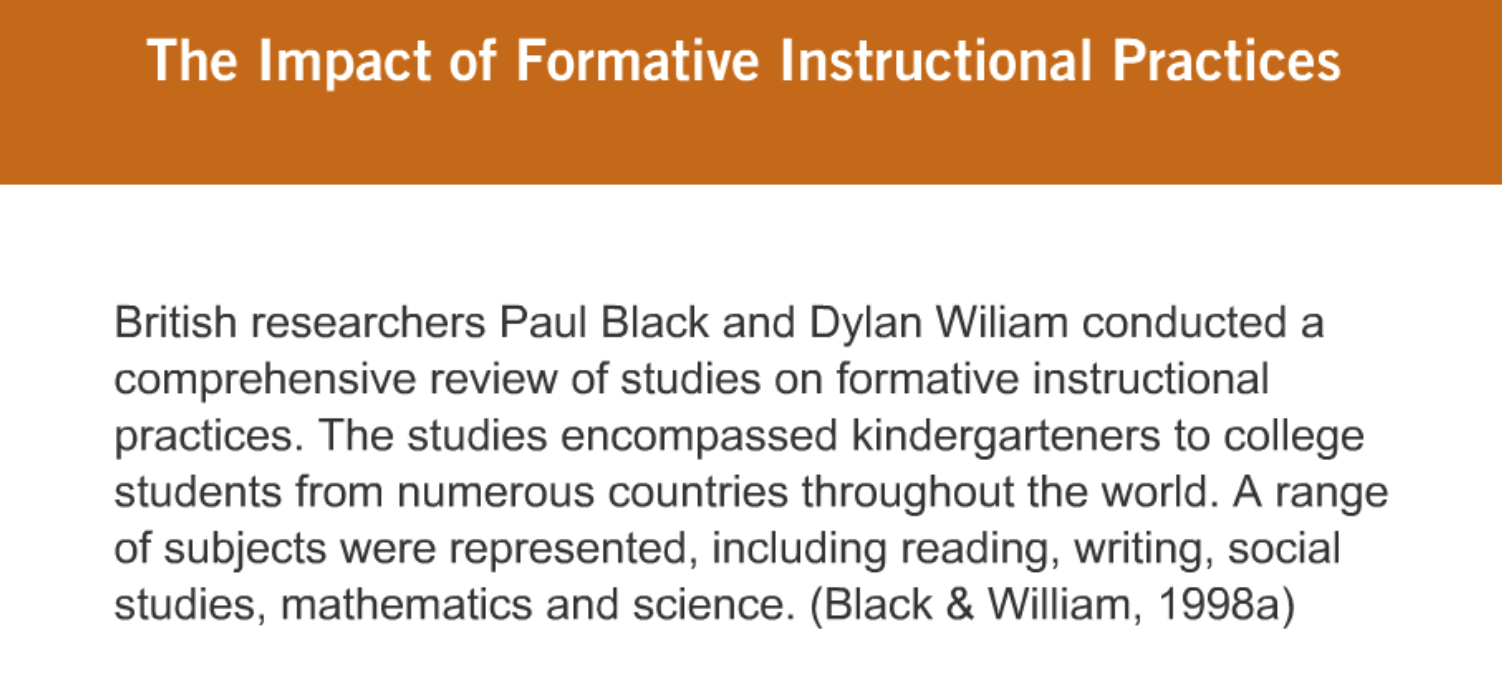
Formative assessment is one the greatest gifts you can give your students. The research is clear–formative assessment helps kids learn. Here are screenshots from a recent lecture I gave students. These slides reference the research of Paul Black and Dylan Wiliam. 

Unfortunately, formative assessment is not done enough. I believe that part of the problem is that teachers simply don’t know enough about it, or how to do it. I was unclear on both of these counts a decade ago. It makes me sad to think of all the students who matriculated through my class before I became aware of this powerful tactic. 

Hopefully, this episode will inspire and enlighten you. I finally have students joining me once again.  Aurora Dollins, Brianna Pasco, and Alex Staton are students in my Assessment class at Muskingum University. I love interviewing Education majors because they have a unique perspective. They get what it’s like to be a student, but they are constantly evaluating how they will utilize approaches and tools once they become instructors. 

ALex Statton, Aurora Dollins, and Briana Pasco

Aside from the ideas of these awesome young women, I want to offer additional help in your quest to craft engaging and relevant formative assessments, Here’s an outstanding link to a slide presentation created by David Wees which includes 56 ideas for formative assessment. 

Episode Template

The Problem:

Formative assessment is not utilized enough. 

The Solution:

Start including formative assessments with each unit you teach.

What you can do Tomorrow:

  • Search David Wees’ link for an engaging and relevant option.
  • Try it.
  • Debrief students and gameplan on how you can improve.

Formative assessment is backed by research. Your challenge is to make it engaging and relevant.  

Episode 139 Path 44…Starring Dr. Dorothy VanderJagt is Prompting you to Pause

My new book Teaching in Magenta aids teachers in the creation of deep well-being and profound joy. My Path 44 describes a method to gain some peace and perspective in the midst of a hectic day:

Path 44

It was late March in Ohio. My wife and I were on spring break, and the weather was beautiful. We decided to take a hike, and as Roberta Flack once sang, “Watch winter turn to spring.” It was invigorating. It reminded me of one year when I had my planning period the last period of the day. On days when it wasn’t raining or snowing or below freezing, which describes a lot of days in Ohio, I would leave school and walk to our stadium. I would then stroll one lap around the track. After my lap, I’d return to my room and be productive. It was awesome. I’m going to start doing that again. Today, carve out fifteen minutes to leave the institutional atmosphere of the school and energize yourself outside.

Today, I’ll interview someone who couldn’t agree more. In fact, she wrote a book about obtaining this tranquility and clarity.

Dr. Dorothy VanderJagt and I have recently become friends. Dorothy is veteran educator from the great state of Michigan. She’s been a middle school teacher, an elementary principal, a central office administrator, and a college professor. That’s, a lot of perspective. 

Dorothy VanderJact

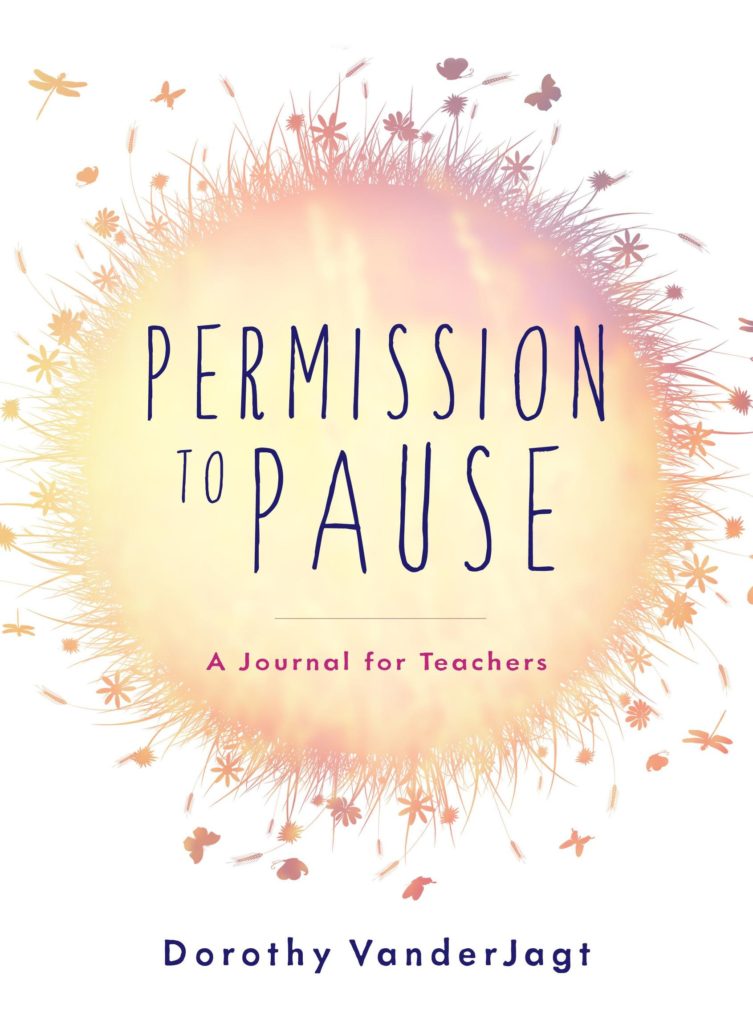
Two months ago, her brand new book Permission to Pause was released. Her timing was perfect. This book will help discombobulated teachers get their bearings and evolve into a state of well-being. While her timing on releasing this book is perfect, it’s worthy COVID or not. Dr. Dorothy wants teachers to pause and reflect. I’m a big fan. In this episode, she’ll tell you why it’s important to pause and reflect and how you can do it! 

Ask yourself these questions:

Now that school has started, do I feel overwhelmed?

Do I find my mood impacting interactions with my family and students?

Am I not doing as good a job on any one thing because I’m pulled in so many directions? 

If you answered yes to any of those questions, Dr. Dorothy’s book is available for a house call.