99-If the Statue of Liberty were a teacher…how would she handle kids who struggle with English? Starring Diann Espinoza

America is changing. According to Pew, by 2050 the US will be 29% Hispanic. If you don’t have kids in your class who struggle with English, you will in the future. If you have students who struggle, expect a lot more. I’ve spoken to colleagues who’ve experienced such students. Many of these educators expressed frustration. They lack training and resources. In prepping for this episode, I concluded that teachers need to strive to be like the Statue of Liberty…SAY WHAT!?!

“Give me your tired, your poor, your huddled masses yearning to breathe free, the wretched refuse of your teeming shore,” she wrote. “Send these, the homeless, tempest-tossed to me, I lift my lamp beside the golden door!”

The golden door is an education. Embrace these youngsters. Think how stressful it is for them to not feel free to express themselves.

In this episode, I interview a bilingual champion by the name of Diann Espinoza.
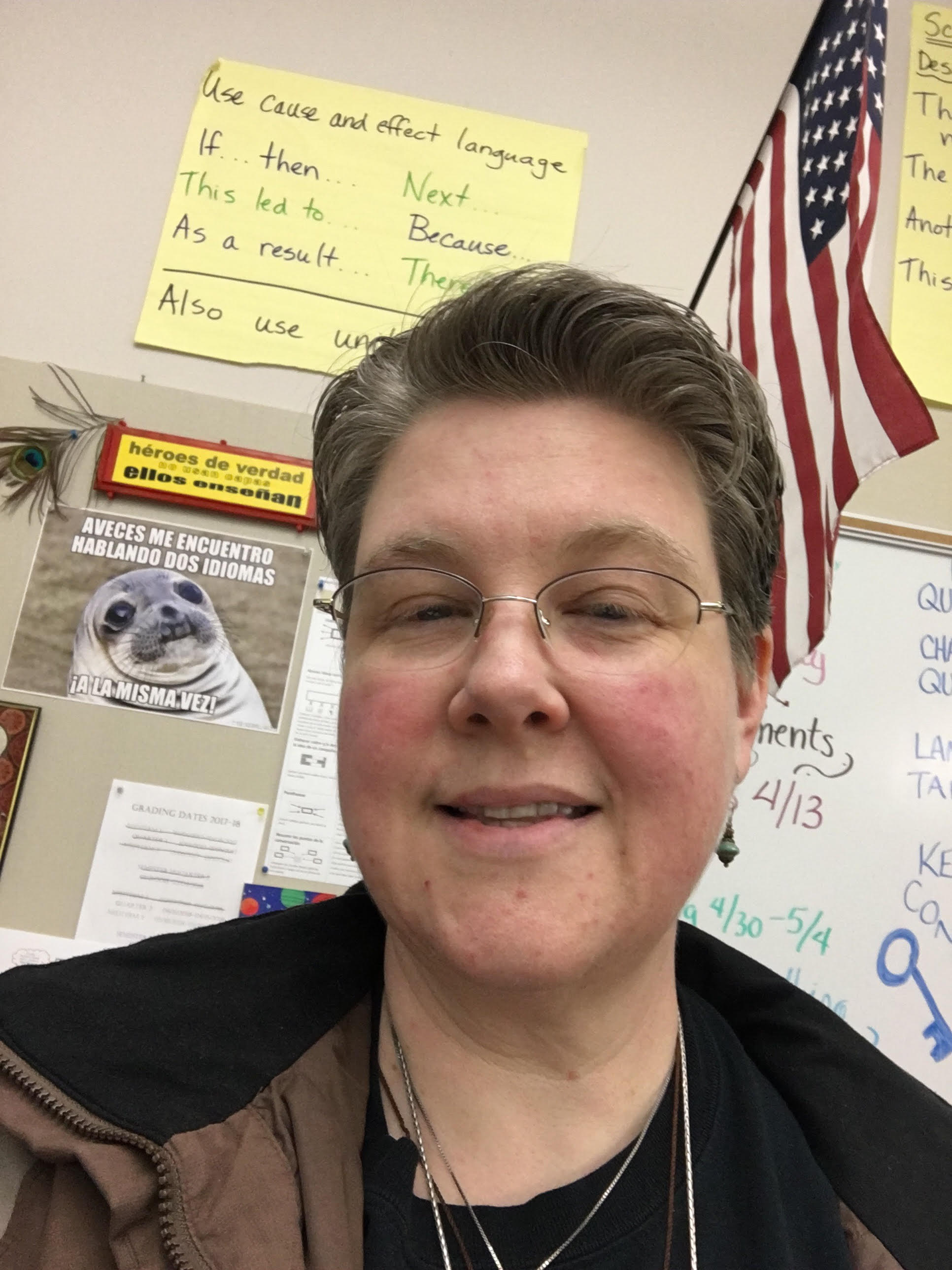
Diann Espinoza

Diann teaches Science at South Meadows Middle School in Portland, Oregon. Diann’s wonderful school fully embraces bilingual education. Below are some of Diann’s ideas on how to help students succeed who struggle with English:

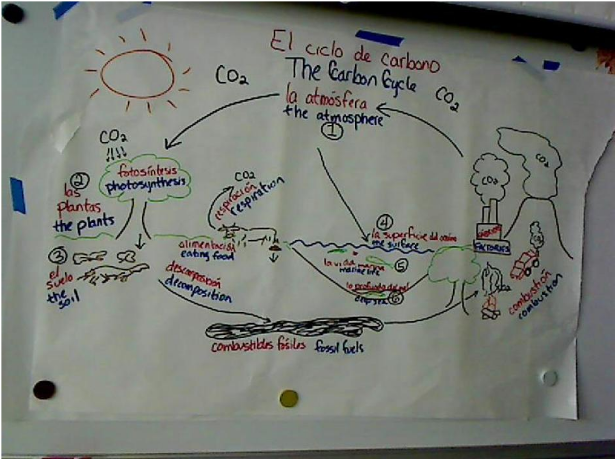
Bilingual teachers must assist students with strategies for bridging the two languages. There are specific methods that we learn to employ like showing students words that mean the same and look very similar in both languages, these are called cognates. We do lessons where we make anchor charts with the students that have color-coded bilingual components pointing out the prefixes that are used commonly in each language or things like tricks they can use when they are working in English that give them clues from the Spanish that they know or vice versa. An example would be adjectives that end in -ly in English tend to end in -mente in Spanish like (actually and actualmente).  We also use TPR and diagrams or drawings with bilingual labels that have been added during a lesson with all of the students. These resources stay on the walls for reference.
One of the hardest things about being a secondary bilingual science teacher is finding connections with others who do the same thing. I attended a national conference this summer and connected with another middle school science teacher. It is his first year this year and the first year for his school to add a dual language program. We have communicated a bit but mostly I feel that I am the one who is sharing everything that I have learned as a solo teacher from trial and error.

There is a difficulty with students wanting to speak in the language of power (English, of course), especially as they get older and in middle school most of the time I hear them conversing in English. Their lack of enthusiasm for learning in Spanish puts a dent in their progress and therefore, presents a troubling challenge. 

One thing I can think of right away is encouraging these students to do their initial thinking and writing in their native language so that they can organize their thoughts and then work from there to complete the work in what limited ways they can in English. This is called translanguaging. Often in bilingual learning spaces teachers encourage students to do this so they can see what students know how to do in each language. Over time they find that the writing produced is more detailed

Another is to have them produce vocabulary work in English but then to also have a space on the activity for them to write the word and maybe a definition or a sentence in their own language too.

This is a picture of an example vocab poster that my dual language class made with the word in English and also in Spanish.

Finally, when new unit vocab is introduced, have a word wall or other shared place where the whole class can see. Ask students of other native languages to bring the words from home for the new vocabulary and include those in that space for all to see.

In this way, the home language and culture is honored and they can see that their contributions are appreciated. If you make this a practice from the beginning, then hopefully they will not feel stigmatized or weird for using their home language but rather, if the teacher creates the expectations, they will feel more confident that they have a treasure to draw from and even an advantage for their learning success, because they actually do!

Diann Espinoza

My favorite ideas is to merely take the HyperDoc, which represents the lesson prompt, and translate in Google!
Episode Template

The Problem:

Many teachers are at a loss with how to help kids who struggle with English.

The Solution:

Implement Diann Espinoza’s ideas.

What you can do Tomorrow:

  • Develop empathy for kids who struggle with English.
  • Translate your lesson prompt HyperDoc. 
  • Encourage kids to initially express in their native language.
  • Utilize images and drawing.
  • Unleash physical expression.
  • Foster relationships with students who may feel isolated.

America is becoming more diverse. Embrace the future. Help kids who struggle with English. They need you!

Listen to “99-If the Statue of Liberty was a teacher…how would she handle kids who struggle with English…Starring Diann Espinoza” on Spreaker.

98-StoryboardThat will Transform your Kids into Editorial Cartoonists

When I was a young teacher, I used to bring my newspaper to study hall. Students would perch on their desks and observe me like vultures. As soon as I was done with the Sports Section, or the Life Section, they would swoop down and devour it! Today, I’m not sure kids could identify a newspaper in a police lineup. What I loved the most about consuming the newspaper each day was the Comic’s Page and the Editorial Cartoons. Unfortunately, I don’t get a paper anymore. My exposure to comics has diminished significantly. I miss them!

So…in this episode, I’ll demonstrate how to revive this wonderful medium with the help of a tremendous tech tool called StoryboardThat. I’ll also give non-humanities teachers an idea on how they could use it in their curriculum.

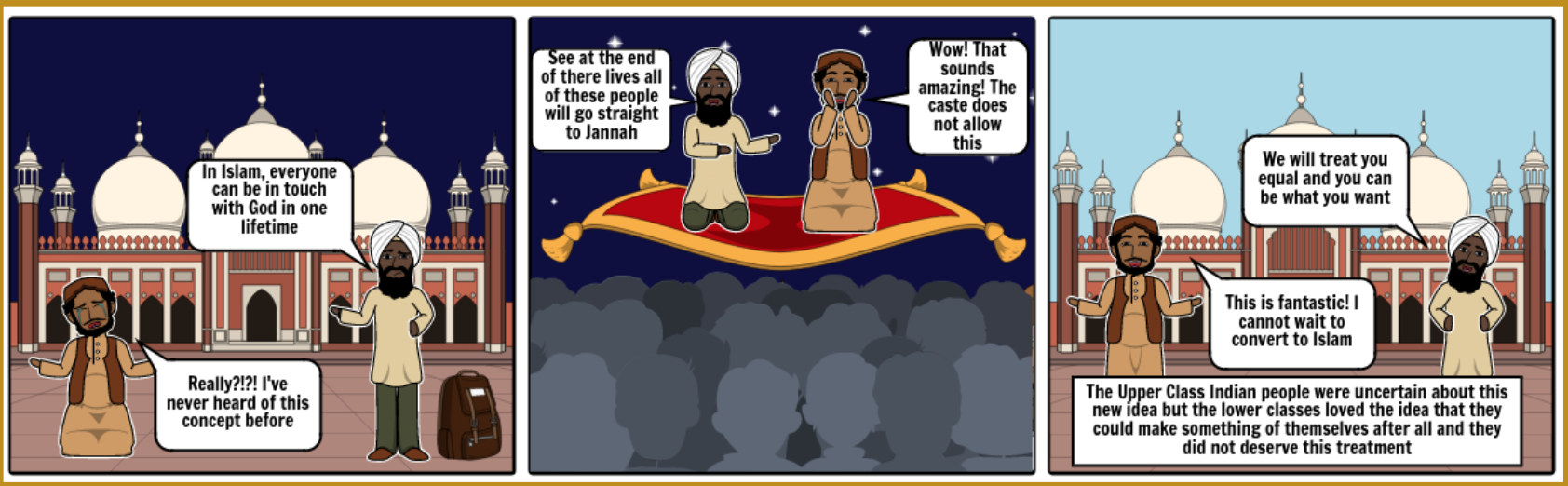
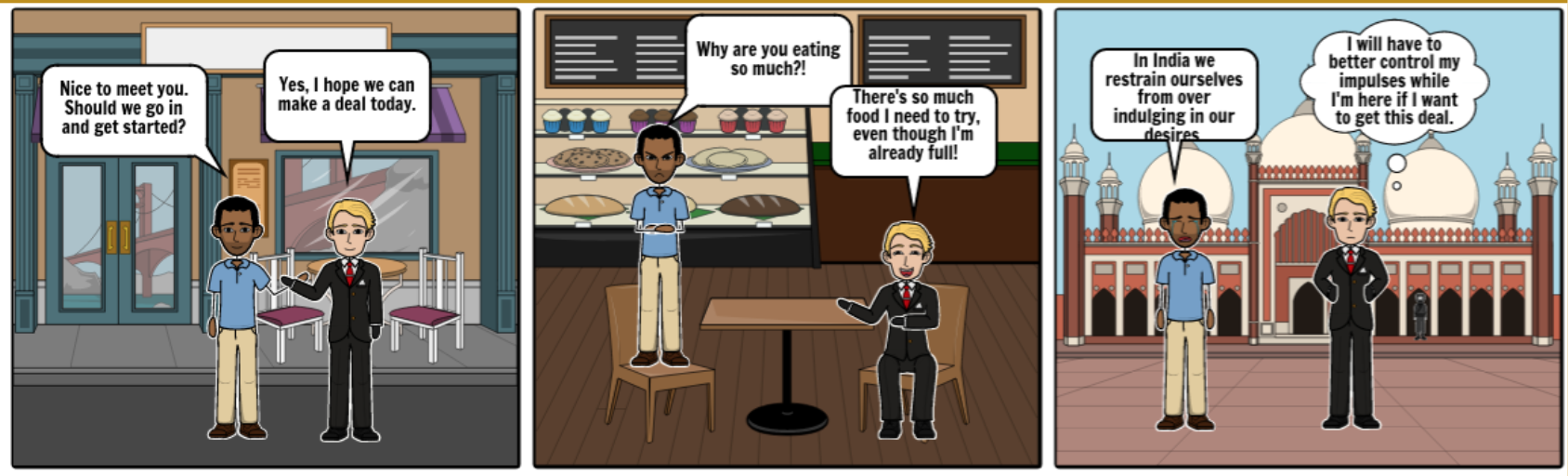
To start, however, I must explain the prompt I layed on my kids. Episode 92 featured Brad Gosche of the Columbus Council on World Affairs. He introduced me to Geert Hofstede and the Country Comparisons Model. My lesson built off this exposure. My students were required to craft a comic where they played the role of a Westerner attempting to interact with India. Here is a link to the HyperDoc I assigned on Google Classroom. Students then created amazing 3-panel comic on StoryboardThat fulfilling these 3 jobs:

Panel 1:

You’re a foreign power describe YOUR OBJECTIVE in India. It could be setting up colonies in the past, or doing business in the present.  

Panel 2:

Describe the applicable CULTURAL DIMENSION.  

Panel 3:

Indicate how your ADJUSTED APPROACH will succeed.

Finally, kids shared their comics with classmates on a class Google Slide presentation.

Episode Template

The Problem:

Comics are an underutilized medium for student expression.

The Solution:

Challenge kids to create with StoryboardThat.

What you can do Tomorrow:

  • Become familiar with StoryboardThat by creating your own comic.
  • Craft a 3-panel comic prompt.
  • Demonstrate to students some of the StoryboardThat featured in this episode.
  • Create a Google Slide presentation to act as a landing pad for finished comics.

Your kids will have an absolute blast with this tool. They also will demonstrate deep understanding about their topics.

Listen to “98-StoryboardThat will Transform your Kids into Editorial Cartoonists” on Spreaker

97-The Virtual Gallery Walk Compliments of Screencastify

Student videos started to get on my nerves. It was the same thing over and over. The kids put most of their efforts into making them funny and violent. The videos seemed more slapstick than expressive.

I retooled the way kids create videos and the results have been spectacular. This episode is about HOW I have my students do this and HOW they present their work to one another. Episode 44 is about student presentations via the gallery walk. In this program, I’m going to promote the idea of creating a virtual gallery walk. I was impressed a couple of years ago when I had my kids take a virtual tour of the Caves of Lascaux.  I remember thinking…Wouldn’t it be cool if my kids could create a virtual exhibit?

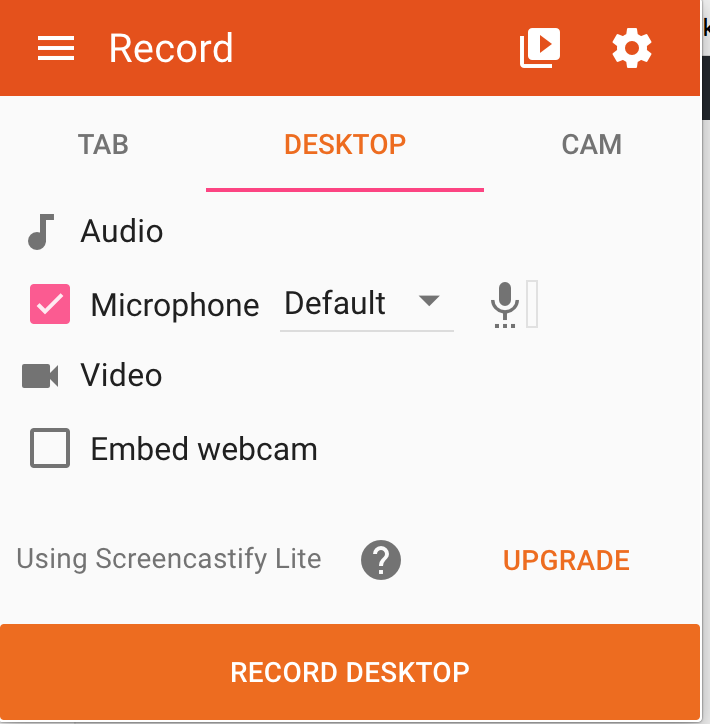
My students mastered this challenge with the help of Google Slides and wonderful screen recorder called Screencastify.


Building off the ideas Jason Connally proposed in Episode 96, students built a 1-2 minute video with Screencastify, uploaded it to YouTube, and then placed a link on a Google Doc which acts like a landing page. This landing page then became the virtual museum. On exhibition day, students wandered from exhibit to exhibit and learned from their classmates…all in a virtual fashion!

Episode Template

The Problem:

Student videos need a makeover.

The Solution:

Utilize Google Slides and Screencastify.

What you can do Tomorrow:

  • Create a prompt for kids such as have students describe a concept, place it context, and then determine its significance.
  • Have students build a Google Slide presentation that is image rich and text poor. 4-5 slides is perfect!
  • Direct students to craft a script that tells a story about the compelling images on the presentation.
  • Have kids utilize the Screencastify addon to record their desktop as they tell a great story.
  • Students then upload the video to YouTube.
  • The last step is for kids to put the link on a Google Doc which acts like a landing page. This landing page will be the virtual museum.

Take your student’s video presentations to a whole new level!

Listen to “97-The Virtual Gallery Walk Compliments of Screencastify” on Spreaker.

96-Jason Connelly is the Man Behind the Curtain…Crafting Powerful and Futuristic Classroom Presentations

Many moons ago, I read a fascinating book about the future. Bill Gates’ book The Road Ahead inspired me greatly. I couldn’t wait to see if Gates’ fascinating predictions came to fruition. Guess what…most did!

This episode will feature a Gates-like futuristic prophet in regard to lesson delivery.

Jason Connelly

Jason Connelly is an instructional designer at Columbus State Community College. I became acquainted with Jason last year. Columbus State commissioned your humble narrator to create the online version of World Civilization. In this massive creative challenge,Jason was my mentor and muse.

I’ve taken all that I learned from Jason and applied it to my virtual lesson creation. I’ve guided student to create superior projects based on what I learned from Jason. Don’t be intimidated by what you hear today. In my next episode, I’ll explain how to transform a basic storyboard, which I encourage you to create, into a powerful video. Here’s a 3:21 example of Jason and my efforts:

Next weekend I’ll be in New Mexico with my lovely wife on spring break. I’ll be back in 2 weeks with easy instructions for transforming your storyboard into a powerful video!

Episode Template

The Problem:

Lesson delivery is need of an upgrade.

The Solution:

Create lessons that are portable, interactive, and collaborative.

What you can do Tomorrow:

  • Search your current unit for an engaging lesson that you could transform into a short video.
  • Create a storyboard on Google Doc. This doc will be the script for your video.
  • Secure compelling images for each chunk of your narrative. Use the insert tab on Google.

The next episode will provide the technical instructions. We’ll take our storyboard and morph it into a captivating video. Stay tuned!

Listen to “96-Jason Connelly is the Man Behind the Curtain…Crafting Powerful and Futuristic Classroom Presentations” on Spreaker.

95-Your Step-by-Step Guide to an Epic Class Discussion Sturtevant-Style

In the midst of your last class discussion, you may have felt some pangs of disappointment. Perhaps, there was not enough engagement. Or maybe, the participation level was not satisfactory. Some students may have monopolized the airwaves. Well…I’m here to help.

In this episode, you’ll be treated to a step-by-step approach to epic class discussions. This template can be used repeatedly. Welcome, dear friends, to Philosophical Chairs Sturtevant-Style!

Step 1: Formulate a topic. This doesn’t necessarily have to be an ultra-engaging topic. Last week, my fourteen-year-old freshman dove headfirst into the issue of Indian Partition in 1947. You will not catch these kids tweeting about Nehru, but they sure were invested in debating about him. It was shocking how well it worked. That’s what the tactics I’ll outline can accomplish. You can make a pedestrian topic enthralling.

Step 2: Accumulate compelling sources. Here’s a link to the hyperdoc which set up my discussion on the slave trade. The primary sources come from the Stanford History Education Group. Please check out Episode 40 if you’d like to learn more about thee free resources. Embed provocative prompts inside the sources to get the kids thinking.

Step 3: Create a self evaluation sheet for students. Here’s mine. This sheet will add accountability. The students will demonstrate that they digested the prep material and be motivated to participate in the discussion.

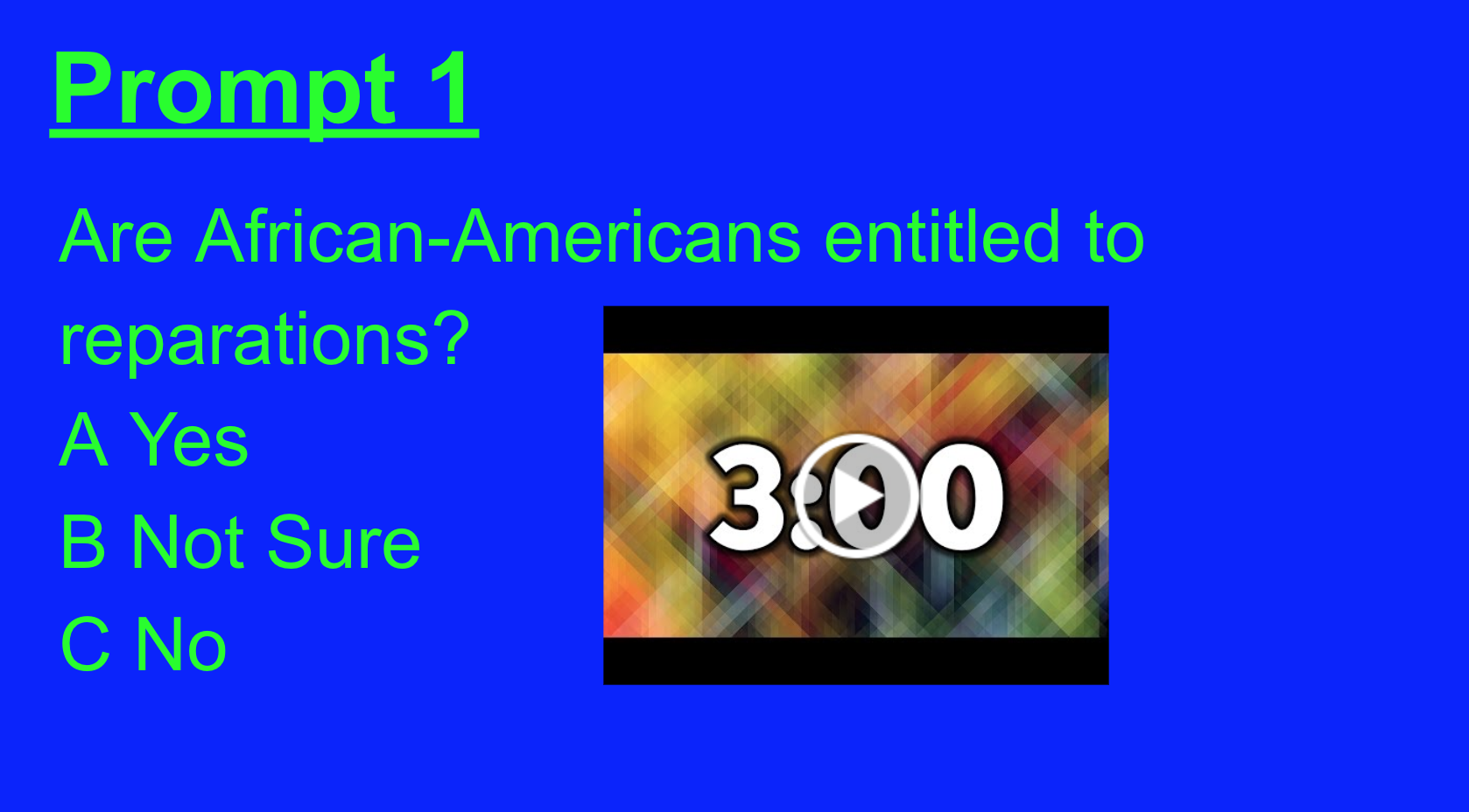
Step 4: Compose 4 or 5 prompts. Students will have 3 choices with each question:

  • A Yes
  • B Unsure
  • C No

The prompts will be unveiled to the kids and then they’ll be given 3 minutes to formulate responses. They should review the prep material and certainly conduct internet searches as well. Here is my slide presentation. 

Step 5: Arrange the room so there’s 3 different sides. This is where the kids will go to demonstrate their feelings about the prompt. I have the A and C sides face one another and the Bs I place in the back facing you. Students should be encouraged to migrate freely during the discussion. It’s quite fine if they change their minds and it’ll give them an opportunity to contribute by explaining why they moved.

Step 6: Embrace the role of debate moderator. Draw kids out, call on reluctant students, ask students who move for an explanation, summarize a kid’s thoughts to help them express themselves, and occasionally, play devil’s advocate…but remember, your goal is to remain neutral.

Please try this Sturtevant-Style discussion. At the end of the class, there’ll be a number of hands frozen in the air…their disappointed owners sad that they couldn’t contribute just one more thought.

Listen to “95-Your Step-by-Step Guide to an Epic Class Discussion Sturtevant-Style” on Spreaker.

94-Usher in Relevance Courtesy of Elon Musk and Peergrade…Starring Mitchell Charles

I get frustrated when I’m asked to do something irrelevant. Don’t you? And yet, many teachers dread when students ask, “When am I ever going to need to know this stuff?” It’s a rather obnoxious way of asking, “Is this lesson relevant?”

Now, picture this. You craft a lesson that is so relevant that you hope some kid inquires! This episode is designed to help you create such a lesson. To help in this mission is an awesome primary source.

Mitchell Charles

Mitchell Charles is an articulate young man destined for academic brilliance.

In World Civilization, we were meandering through a unit on the Industrial Revolution. This topic typically leaves some students cold. My challenge was to make it relevant. I did this with the help of Elon Musk and Peergrade. Below is the lesson that Mitchell evaluates in this episode. Please feel free to commandeer some of it, or all of it!

Applying the Industrial Revolution via Elon Musk

History students often complain that what they study doesn’t seem relevant. You may have heard the cliche, History repeats itself. You may, or may not be persuaded by this idea, but hopefully you’ll concede that the study of history at least gives us templates through which we can better understand the present. Technological changes that are at work today have the potential of reshaping the world along the lines of the changes brought about by the Industrial Revolution. Studying how that unfolded has the potential to make a young person more adaptable.

Elon Musk is one of the world’s most interesting and perhaps most impactful citizens. Musk is determined to improve the way you live. He also is determined to help the USA win back it’s manufacturing advantage. This man has the potential to create products and systems that are as impactful as anything we’ve studied so far. He was born under the yoke of Apartheid in South Africa and as soon as he was able, he migrated to Canada and then the USA. He’s now a US citizen.

I first became interested in Musk when I saw him appear on the Big Bang Theory many years ago. If you’d like to learn more about this compelling man, read this Rolling Stone article, or this fascinating book.

We’ll focus on 4 of Musk’s objectives:

  1. SpaceX
  2. Tesla
  3. SolarCity
  4. The Boring Company

Job 1: Become familiar with your topic by reviewing the links and conducting online research.

Job 2: Meet with other students who’ve been assigned the same focus. Dialogue about the company. You certainly don’t have to agree, but consider the views of your classmates.

Job 3: Individually, Respond to the prompts on the appropriate doc on Google Classroom.

Job 4: Upload your views to Peergrade.

Job 5: Evaluate your peer’s ideas via Peergrade.  

Each student has been assigned a focus. Here are some links, but please don’t limit yourself to only the links I provide.

SpaceX

Start your research by visiting the company website. Then navigate to this objective article. Conduct research on this entity including a video search.

Tesla

Start your research by visiting the company website. Then, navigate to this objective article. Finally, conduct research on this entity including a video search.

SolarCity

Start your research by visiting the company website. Then, navigate to this objective article. Finally, conduct research on this entity including a video search.

The Boring Company

Start your research by visiting the company website. Then, navigate to this objective article. Finally, conduct research on this entity including a video search.

Elon Musk Reaction Prompt

Build your responses based on your research. Each prompt is worth 10 points. Elaborate on your ideas. Don’t just give 1 word, or 1 phrase answers. Compose a narrative for each prompt.

  • Pretend that you are Elon Musk. You’re appealing to a number of venture capitalists with the goal of having them invest. Provide your audience with a sales pitch. This has nothing to do whether you…as in you personally, not as in you pretending to be Elon Musk…think the venture will be successful.
  • Indicate whether you think this venture is feasible. Don’t just respond yes or no. Explain why, or why not, you think it’ll work.
  • The inventions of the Industrial Revolution changed people’s lives in fundamental ways. Do you believe this venture will change lives and if you do, in what way and if you don’t, why not?
  • Pretend that you’re in this class and it’s 200 years in the future. Your instructor, who is a remarkably improved version of yours truly, asks you to describe Elon Musk, place him in context, and describe his significance.
  • Indicate something that you would like to see invented. This needs to be an innovation that will dramatically improve life on earth. Describe it, explain how it works, and predict how it will improve life.

Episode Template

The Problem:

Students often feel lessons are irrelevant.

The Solution:

Craft lessons where kids are challenged to apply what you’re teaching to their lives.

What you can do Tomorrow:

  • Brainstorm real world applications for tomorrow’s lesson
  • Break your students into 4 topics or problems and then challenge them to respond to provocative prompts
  • Have kids submit their work to Peergrade and then watch a virtual Socratic Seminar unfold before your eyes

Teaching relevance is the responsibility of every educator. Teaching relevance will empower you to embrace the question, “Why do we have to learn this?”

Listen to “94-Usher in Relevance Courtesy of Elon Musk and Peergrade…Starring Mitchell Charles” on Spreaker

93-The Evolving Seamless Relationship Between K12 and Higher Ed…Starring Penny Sturtevant

I get inspiration for my episodes from odd sources. One of my New Year’s resolutions is to read more. The past few years, I’ve been busy writing my book, so I had zero time to consume words because I was too busy creating narratives. That’s changed and it’s delightful. Currently, I’m reading Elon Musk: Tesla, SpaceX, and the Quest for a Fantastic Future by Ashlee Vance. This book is about Musk’s incredible vision, his entrepreneurial spirit, and his dogged determination. The book is also about how crucial it is to embracing change. I’ve been inspired by reading it!

Consequently, I needed to bring a change agent on my podcast. Penny Sturtevant is the College and Career Readiness Coordinator for the Big Walnut Local Schools.

Penny Sturtevant

Penny is an expert on prevailing trends in education in regard to career ed and college readiness. We discuss the brave new frontier of K12 and Higher Ed’s evolving relationship. In the title, I utilized the word seamless. Listen to this powerful episode to learn why.

This program does not feature a tactic, a tool, or a lesson to specifically engage kids. Instead, this episode could inspire you to seek out an enrichment path for your students. If you’re successful, I predict you’ll be greatly inspired as well.

Listen to “93-The Evolving Seamless Relationship Between K12 and Higher Ed…Starring Penny Sturtevant” on Spreaker.

92-Flavor Tomorrow’s Lesson with an International Perspective…Courtesy of Brad Gosche and the Columbus Council on World Affairs

I’ll bet you’ve heard your students complain about where they live…the community where you teach them by the way. I did my share of whining when I was a teen. I felt like little New Concord, Ohio was nowhere. And yet, there’s virtually no nowhere anymore! We all live and function in a global economy. If your students don’t believe it, have them conduct a simple inventory of what they’re wearing and carrying. Ask them to record where all of their possessions are manufactured. I’ll bet they’re not lugging around to much Made in the USA.

Unfortunately, some in our nation would like to be isolated. This is a fool’s errand. Students, on the other hand, who embrace the international nature of modern existence will prosper. Teachers, therefore, have an obligation to help students pursue and master this paradigm. To help in this quest, today’s episode will feature the urbane Brad Gosche.

Brad Gosche

Brad is the Vice-President of Education and Communication at the Columbus Council on World Affairs.

@CbusCCWA

Here’s the council’s two-fold mission:

To be the leading nonpartisan, globally-focused organization in the Columbus Region. The Council fosters a community that is well-informed about critical international issues as they affect the world, nation and the local region, and whose citizens utilize this insight to make effective decisions in our global society.

This episode will not only inspire you to include a global perspective in your curriculum, it will also provide two outstanding activities you can employ tomorrow. The first is Geert Hofstede’s country comparison model. The second is taking your kids on a wonderful Trip to Mintana. Please listen to this powerful episode for descriptions of and solid ideas about how to use each.

Episode Template

The Problem:

Students are unaware of the global nature of their existence.

The Solution:

Infuse lesson plans with an international perspective.

What you can do Tomorrow:

Unveil a global perspective to your students and empower them to prosper!

Listen to “92-Flavor Tomorrow’s Lesson with an International Perspective…Courtesy of Brad Gosche and the Columbus Council on World Affairs” on Spreaker.

91-Can your Students Spot a Fascist? Starring Scott Elliott

If you’ve taught a humanities class, you’ve probably recognized how frequently Adolf Hitler comes up. Unfortunately, many kid’s understanding of Hitler and Fascism doesn’t expand much past the Holocaust.

Scott Elliott teaches 9th Grade World History with me.

Scott Elliott [email protected]

Right before Christmas Break, we were yakking about how we could teach Fascism, our first unit in January, in a more engaging and impactful way. Scott found a wonderful resource which formed the backbone of the assignment. The article is by Laurence W. Britt and is entitled Fascism Anyone. The assignment we created challenged kids to rate WWII leaders on the 14 Characteristics Britt articulates and also to apply them to current leaders with authoritarian traits. Here’s a link to the hyperdoc we posted on Google Classroom. Below, are Britt’s list of 14 Fascist Characteristics:

  1. Powerful and continuing expressions of nationalism. 
  2. Disdain for the importance of human rights. 
  3. Identification of enemies/scapegoats as a unifying cause.
  4. The supremacy of the military/avid militarism. 
  5. Rampant sexism.
  6. A controlled mass media. 
  7. Obsession with national security. Inevitably, a national security apparatus was under direct control of the ruling elite.
  8. Religion and ruling elite tied together. 
  9. Power of corporations protected.
  10. Power of labor suppressed or eliminated. 
  11. Disdain and suppression of intellectuals and the arts.
  12. Obsession with crime and punishment. 
  13. Rampant cronyism and corruption. 
  14. Fraudulent elections. 

This turned into a solid activity in our World History class, but the lesson can be applied outside of the humanities. Perhaps, there are misunderstandings about important concepts in other subjects. I can certainly think of examples in Science. Challenge kids to apply agreed-upon standards to a set of contentious circumstances.

Episode Template

 The Problem:

Students freely use words like Fascist, Nazi, and Hitler with limited knowledge of these label’s broader meanings.

The Solution:

Expose kids to what Fascism is and then challenge them to apply it.

What you can do Tomorrow:

  • If you teach a humanities course and Fascism is a topic, please steal our lesson and morph it to fit your needs.
  • If you teach a non-humanities class, take a controversial or misunderstood topic, expose students to some agreed-upon standards and then challenge them to apply that knowledge.

Please inspire your kids to pursue objective truth relentlessly. Assignments such as this will nurture this essential disposition!

A quick program note…I referenced in the podcast Rosa Parks bus protest, but I inadvertently placed it in Birmingham instead of Montgomery where it belongs. Sorry!

Listen to “James Sturtevant Hacking Engagement” on Spreaker.

90-CYOA (Choose Your Own Assessment)…staring Louis Soper, Will Koppmann, and Mae Reasner

Occasionally, I’ll interview a guest who has their own blog. That is certainly the case with Louis Soper. Louis is a middle school social studies teacher in Lancaster, Pennsylvania. Louis has done a remarkable job of empowering his kids to demonstrate their learning. He refers to this process as CYOA, or Choose Your Own Assessment. To help in this endeavor, Louis deputized two of his outstanding students Will Koppmann and Mae Reasner.

I could describe Louis’ process, but I’ve learned that duplication of effort is counterproductive. Instead of me describing his efforts in a hearsay fashion, please migrate to Louis’ blog on this topic and read the primary source!

Episode Template

The Problem:

Mass-produced assessments don’t empower kids to demonstrate their passions.

The Solution:

Institute a CYOA assessment at the conclusion of a unit.

What you can do Tomorrow:

  • Gaze at yourself in the mirror and repeat the following, It’s okay to allow kids to demonstrate learning in their own way.
  • Pick a low-risk unit which would serve as great testing ground.
  • Create a list of student options for a CYOA assessment prompt.

Student-led learning is a powerful tide in American education. Wax up your board and hop along for the ride!

Listen to “90-CYOA (Choose Your Own Assessment)…staring Louis Soper, Will Koppmann, and Mae Reasner” on Spreaker.